Millennium
A full-stack collection tracker for trading-card players: catalog, pricing, and deck data in one typed, containerized app.
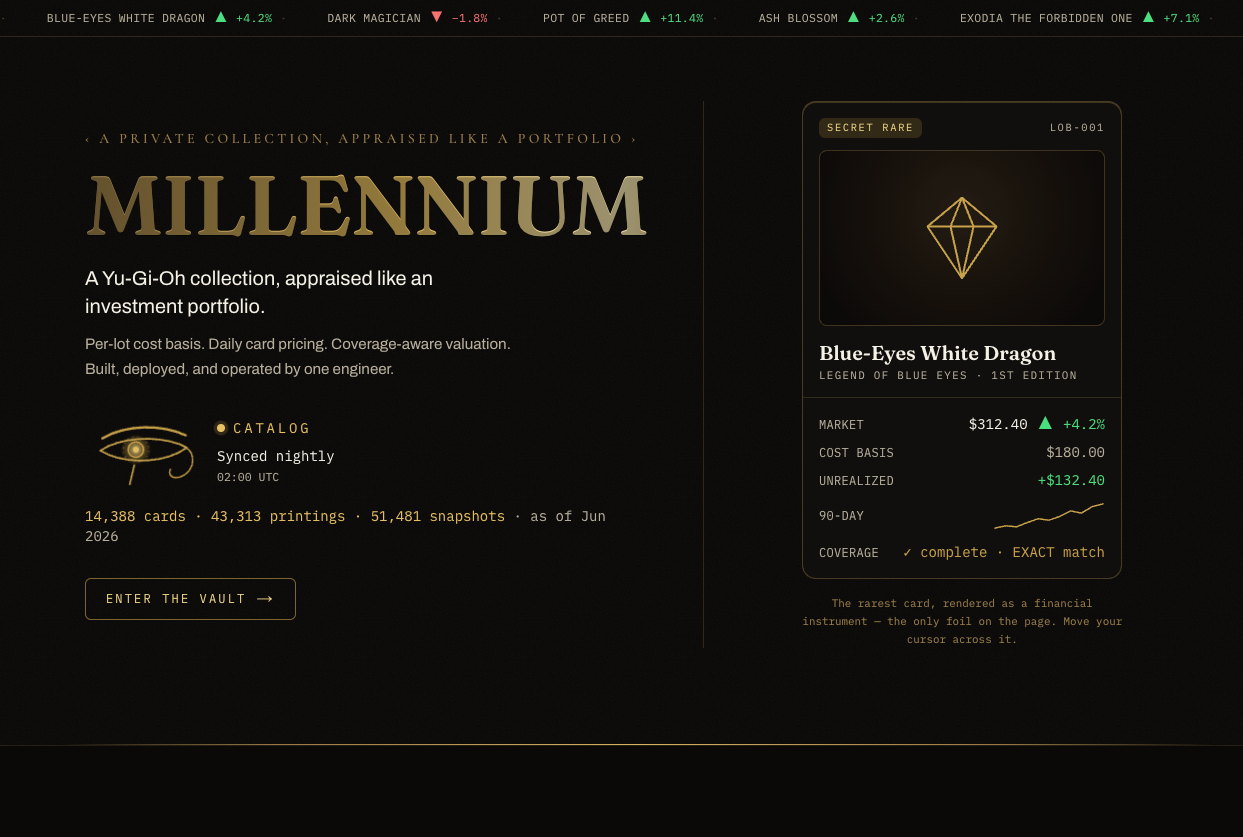
Blue-Eyes White Dragon
Legend of Blue Eyes · 1st Edition
- Market
- $312.40 ▲ +4.2%
- Cost basis
- $180.00
- Unrealized
- +$132.40
- 90-day
- 90-day trend: rising, $168 to $312.
- Coverage
- ✓ complete · EXACT match
Figures illustrative · model is live
- 10Django apps
- 14typed React screens
- 821automated tests
- 43,313card printings
- Per-lotcost-basis valuation
Context
Trading-card players track a sprawling catalog, volatile prices, and their own collection across spreadsheets and half a dozen sites. None of it reconciles, and a misread row quietly corrupts what a collection is worth. Millennium is the tool I wanted: one app that holds all of it and treats card data as a first-class, well-modeled domain. It is also my flagship, a system I own end to end and build to the standard I hold at work.
What I built
A full-stack web application for cataloging cards, tracking a personal collection, and valuing it like a portfolio: a typed Django REST API across 10 Django apps, a relational data model, and a Next.js frontend of 14 typed React screens. Import a CSV and it reconciles every row against a 43,000+ printing catalog, then reports per-lot cost basis, market value, and unrealized gain or loss. A live ops dashboard shows what the system is doing.
Architecture
The backend is Django 5.2 with Django REST Framework over PostgreSQL, with Celery running the background jobs: catalog sync and price snapshots. The frontend is Next.js with React and TypeScript, TanStack Query for server-state caching, and Tailwind for the interface. It runs containerized on a single Hetzner VPS behind Caddy, which terminates TLS. Deploys are pull-based: the box pulls the new build rather than a CI runner pushing into it, so nothing outside needs credentials to the server. A nightly systemd timer drives the ETL refresh, and PostgreSQL backups ship off-box to Cloudflare R2, so a dead disk is an inconvenience, not a loss.
Technical highlights
- Per-lot cost basis, append-only valuation. Every acquisition keeps its own cost, so gain or loss is computed per lot rather than smeared across an average. Daily portfolio snapshots are append-only, and a database CHECK constraint stops a gain from ever displaying without complete price coverage. Partial data can’t masquerade as complete.
- Confidence-scored reconciliation. Imported rows match against the 43,000+ card catalog (TCGCSV / YGOPRODeck) and get scored, not guessed, into EXACT versus review tiers. A weak match lands in review instead of silently becoming a holding, because a fuzzy match that turns into money is worse than no match at all.
- 821 automated tests. Valuation math breaks in ways nobody notices until the number is wrong. The pytest, Vitest, and Playwright suite is the safety net that lets me refactor the money path without holding my breath.
- Off-box backups, pull-based deploys. Backups go to R2 on a schedule and the server pulls its own deploys, so the production box is the only thing that can write to itself, and it can always be restored from somewhere a compromise can’t reach.
Tradeoffs
Self-hosting on a VPS, fully containerized and fully typed, with 821 tests, is heavier than a personal project strictly needs. That is the point. Millennium is built to survive production, because demonstrating that I can run something in production is half of what it is for. The cost is real maintenance: I own the box, the backups, and the deploys.
Outcome
Shipped and live at millennium.erickti.com, actively maintained. Per-lot valuation with append-only snapshots, confidence-scored reconciliation against a 43,000+ printing catalog, nightly ETL, off-box backups, and a live ops dashboard surfacing uptime, heartbeat, and deployed SHA, all running on infrastructure I provision and operate myself. It is the clearest end-to-end demonstration of how I build and run a system from an empty repo.
// the product